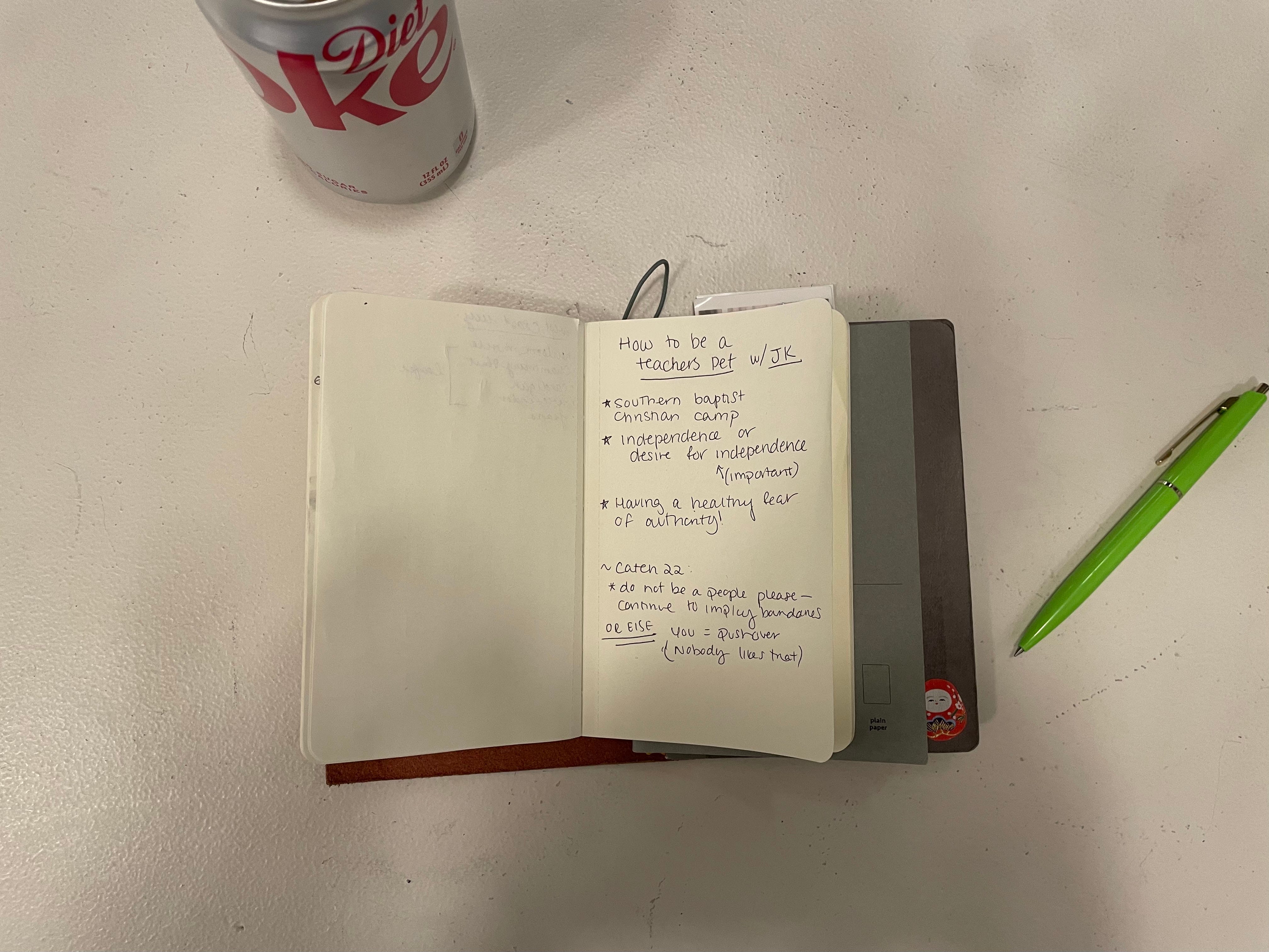
It was a slower day at my retail job, and I don’t remember how it came up, but my friend and I started discussing what it took to make it in the world as a teacher’s pet. As a seasoned pro, I felt I had an obligation to admit my formula. I thought about it for a second while she clicked her pen a few times and found a blank page in her pocket-sized, leather-bound notebook (chic).
I told her the following: to be a teacher’s pet, a solid foundation built by organized religion was impervious. Additionally, an independent spirit cross-hatched by a healthy fear of authority sets the stage for proper servility. Through all of that, though, I told Laurelle, I believe you still mustn’t cross the line into “push-over” or “kiss-ass” when exercising our valuable “teacher’s pet-ness.” Nobody has time for that.
Most of my list was preached in jest, but it’s been a few months since our conversation, and it’s had me thinking about my classroom experiences and how they’ve translated into my adult life. I was always a teacher’s pet in school, aggressively loyal to each pedagogical relationship I was exposed to. I made my teachers, coaches, or [insert any minor authority figure] gods, really. And I think I let it compromise my personality and independence a little. Lately, though, my proclivity toward remaining the teacher’s pet seems to be a subconscious crutch.
…
My first-grade teacher, Mrs. Powers, did not negotiate with nonsense. Not once did I hear her raise her voice, yet there was little to no room for error in her classroom, and we knew it. Highland Park Elementary School was built in 1952—prime time for getting a little eccentric with publicly funded architecture and interior design (a trend whose return I desperately await). Our bathrooms connected each classroom all the way down the first-grade hallway, like a secret tunnel with the same bacterial presence as a petri dish. The bathrooms were also single-stall yet available to multiple patrons at once, as a large wall stood between the toilet and the sink, suggesting that several of my friends and I could have a little party waiting in line if we wanted.
I had Mrs. Powers’ class with Martha, a friend and classmate who briefly lived up the street from me. Martha was herself, absolutely all the time, and it would be a cold day in hell before anything came between her and a good time. We were in the bathroom one school day, and, using the stall first, Martha stood on the toilet seat to send a cheeky little hello over the brick wall. I couldn’t believe it, she was a comedic genius! The air evaporated from my lungs before I could wheeze out a laugh (I was a big fan of the silent laugh as a child). “Martha!” I gasped. “Let me do it, let me do it,” I repeated over and over until, well, she let me do it. A real “so if your friends jump, you would too, huh” situation.
My first mistake was not actually using the bathroom first. My second was underestimating Mrs. Powers’ stealth capabilities. Like a phantom with access to hot rollers and a little lipstick on her teeth, Mrs. Powers appeared in the doorway. My heart dropped instantly, like a magnetic field kicked on between my chest and my lower intestine. All the blood fled my face, following my dignity straight down the toilet, the thing I couldn’t seem to dismount quickly enough. There was no time to prep for receiving my punishment. I had disappointed a woman who stayed in very close contact with my mother and shared the same disposition as Abbott Elementary’s Mrs. Howard. I was toast.
Exiting the bathroom is a blur, as I remember dark spots floating in and out of my vision as an overwhelming anxiety slowly engulfed the rest of my body. Martha and I were both given time spent on “the wall,” a four-inch curb that faced away from the playground and toward the teacher’s picnic table. I’m 99.9% positive that it was 10 minutes each, not even a quarter of recess time. You would’ve thought I was sentenced to life without parole the way I acted.
Our punishment didn’t faze Martha; she knew she had fun breaking the rules and now had to pay for it just a little. However, I genuinely could not face my feelings about my public punishment—not only had I done something bad, but now I was bad. It felt like I was dying, my body slowly deflating and my spirit dissolving into thin air. Grasping at crayons, I did my best to stay inside finishing a class project. But there was no escape. I was bad, and I’d have to sit on the wall for everyone to see.
…
In my senior year of college, a professor of mine held a review session for an upcoming exam. He asked the class if anyone knew anything about a term or principle I can no longer recall, and when he called on me, I made the fatal mistake of starting my answer with the word “like” (god forbid). He picked on me for the rest of the study session, calling on me when I wasn’t raising my hand and looping me into the conversation whenever he finally gave someone else the floor. For the rest of the afternoon and evening, I continued studying for my midterms when, around 8 PM, I received the following email, with a subject line of “note”:
i was playing and hope it came across all in good fun…..
feeling guilty as i walk home
Sent from my iPhone
At first, I didn’t think much of the message until I showed it to my roommates. I think I changed my tone when Ruby so kindly pointed out that it sounded similar to a guilty drunk text that an ex-boyfriend has sent me, not something your professor should send you. I never replied.
Shortly after the email, he chose to pick on me in class. It was a course required for my sociology degree called “Processes of Deviant Behavior,” a fact whose irony is not lost on me. While lecturing on norms, my professor suggested that there are two sets of gendered norms that college students encounter when going out to bars and parties. He noted that, for girls, part of the norm is to try to find a middle ground between being highly attractive and sought-after and being trashy or trying too hard. He turned to the class, and looking straight at me, he said, “I mean, Julia…how do you find the balance between plain hot and too slutty?” First of all motherfucker, it’s Julia Kay. And second, plain hot and too slutty. With that comment, the entire class turned their heads to look at me. The next 30 seconds of my life lasted a generation, shocking me into speechlessness. My face flashed beet red, and I grew hot under my layers, desperate to relax before having to undress myself in any way. Sitting there with my jaw dropped, I was devastated by his behavior and humiliated that I was the target. When all I could offer was a nervous laugh, Professor Sleazebag hurried along with the rest of his presentation.
After this, I’d show up to class in an attempt to garner as little attention as possible. It was an 8 AM, so that was, honestly, remarkably easy to achieve. I never wore makeup, and I kept my hair air-dried and frizzy. I wore layers upon layers, intently ignorant of the staggering temperature in the classroom. I sat in the last row every day in an effort to remove myself from the unsolicited spotlight I’d been granted. In the end, none of my tactics ever really deterred him from showering me with attention.
More emails and comments came in the following weeks. Throughout the semester, I watched when he interacted with other students, specifically other women. It was noticeable that I was getting special treatment. It put a pit in my stomach every time I had to leave for his class, as it felt like he was pushing and pushing, testing for when he’d actually cross the line (as if he hadn’t already). Eventually, I just stopped showing up—I didn’t understand what I could’ve said or done to make him think I was amused by his advances. He changed the rules on me, the stakes suddenly higher than I had ever anticipated, and I was now a part of something I had no recollection of agreeing to.
…
I was seven years old on that toilet seat, certain I had crossed some irreversible threshold into badness, when in reality, Mrs. Powers had to physically remove herself from the doorway so she didn’t break. “Well, they were just a-gigglin and laughin, Jennifer. I had to step out, so I didn’t smile myself,” Mrs. Powers allegedly told my mother after the incident. I spent years carrying around a memory that turned out, at its core, to be a funny story. The punishment was ten minutes on the wall, but the feelings I attached to it had a much longer lease.
At 22, my professor acted inappropriately, and I was naive enough to believe I had encouraged it. Regardless of its nature, some part of me internalized his behavior and labeled myself the problem. I found myself second-guessing my work, wavering in my confidence that I deserved any successes because I worked hard…not because my professor was hoping for more. What I have to keep reminding myself is that I kept my end of the bargain, staying intellectually curious and academically motivated. In an overindulgent move, he jumped at my vulnerability and showed his cards immediately, laying any ulterior motive bare on the table.
Revisiting memories like these matters because real and perceived punishment are usually less catastrophic than they feel in the moment, and distance has a way of returning things to their actual proportions. At 24, I can see Mrs. Powers for what she was—a woman doing her job with warmth and a good sense of humor—and I can see that professor clearly too. We are neither the bad that happens to us, nor the consequences of the rules we’ve broken. Accountability matters, but there’s a difference between taking responsibility or finding perspective and just quietly accepting a life sentence.
I like doing a good job at things and trying to impress the people I’m learning from, but I’m due to find identity outside my immediate authority figures. Growth requires challenge—challenging our beliefs, our biases, the roles we’ve quietly accepted in different relationships—and that kind of challenge doesn’t really happen when approval is the whole goal.
What I’m landing on is that orienting ourselves outward isn’t the problem. Caring about community, wanting to be useful, and finding meaning in what other people need are all good instincts worth keeping. The version that becomes a problem is when we become fear-based, looking outward because we don’t trust what’s within. I think accepting myself as the archetype of the teacher’s pet has been a defense mechanism. I’ve been a little unwilling to truly grow my personal agency, and instead find myself looking to the comment section in everyday life, taking 2nd- and 3rd-opinion advice as my north star. There’s a version of paying attention to the world around you that comes from genuine curiosity and generosity, and there’s a version that is just socially acceptable avoidance. I’ve been running the second one for a while.
Perhaps now that I’m graduated and grown, I’ll have more room to meet myself and wield my autonomy more intentionally. In the end, I learned not to be a jackass in the restroom and that someone’s bad intentions say much more about them than they ever will about you. I think it’s okay to leave the pet behind now.
(never these pets tho xx)